.svg)

.svg)

.svg)

.svg)

.svg)

.svg)

.svg)

.svg)

.svg)

.svg)
.svg)






















Increase Your Team Communication Efficiency with Zenzap's Secure Work Chat App
Internal communication breaks at the worst possible moment. A shift update lives in one app, a task sits in another, and a file is buried in email or a personal chat thread. That is when missed handoffs happen, managers repeat themselves, and teams start running on different versions of the same instruction.
Zenzap fixes that by putting secure workplace messaging, task alignment, file sharing, and scheduling into one organized workspace. For owners, directors, HR leaders, and managers, that means faster decisions, fewer gaps between teams, and communication that is easier to measure and control.
Poor communication is not a soft problem. It is an operating cost, and the cost is high enough to show up in profit, turnover, and productivity. When you use a secure work chat app built for structured team communication, you reduce the scatter that slows every shift handoff, policy update, and location-to-location transfer.
That is the real reason to increase team communication efficiency. You are not trying to send more messages. You are trying to make sure the right message lands in the right place, at the right time, with the right follow-through.
Table of Contents
- Why Team Communication Efficiency Breaks Down
- Step 1: Centralize Chat, Tasks, And Files
- Step 2: Measure What Your Team Actually Needs
- Step 3: Use Structure To Reduce Message Scatter
- Step 4: Protect Access, Offboarding, And Data Control
- Step 5: Improve Coordination Across Locations And Shifts
- Key Takeaways
- FAQ
- About Zenzap
Why Team Communication Efficiency Breaks Down
Communication efficiency falls apart when updates are scattered across tools. The issue is not usually volume, it is fragmentation, and that creates delays, missed actions, and avoidable confusion.
The business impact is measurable. Superhuman cites research showing poor communication costs U.S. Businesses $1.2 trillion annually, while Gallup data cited by Superhuman links strong internal communication to 23% higher profits and 51% lower turnover. MIT research cited by Culture Partners says teams with excellent communication can outperform others by up to 25% in productivity, and McKinsey Global Institute, cited by the University of Minnesota, says employees can be 20% to 25% more productive when companies have an effective internal communication strategy.
That is why the goal is not more noise. It is better structure. When a policy update, handoff note, or staffing change lives in one secure place, teams spend less time searching and more time acting.
What Scattered Communication Looks Like In Real Operations
Scattered communication often starts with one missed message. A manager posts an update in one channel, a supervisor stores the task somewhere else, and a file gets sent by email later in the day. By the time the next shift starts, nobody is working from the same source of truth.
In retail, hospitality, clinics, and home services, that becomes an operational failure, not a minor inconvenience. One location follows the new procedure, another location does not, and the result is inconsistent service, wasted time, and extra escalations.
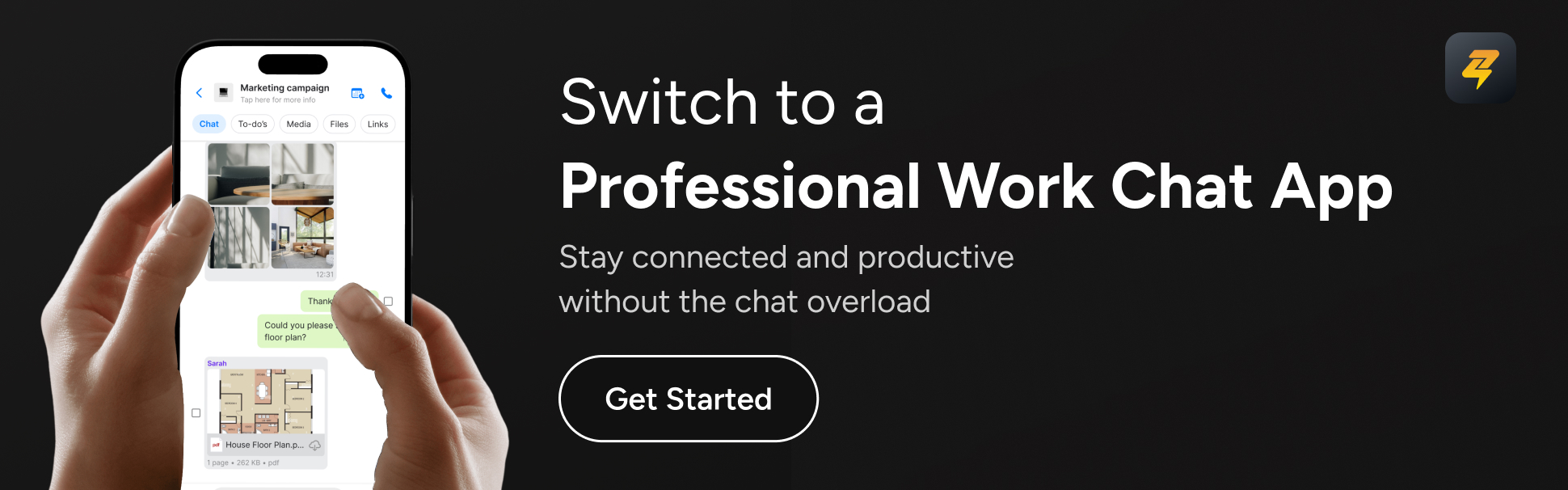
A structured team chat app reduces that risk by tying the conversation to the task, the file, and the follow-up. That is where Zenzap is different.
Step 1: Centralize Chat, Tasks, And Files
The fastest way to improve communication efficiency is to stop splitting work across too many tools. When chat, to-dos, and file sharing live together, fewer updates get lost and fewer people have to ask for the same context twice.
Zenzap is a modern communication platform designed to streamline messaging across teams and groups in a single, organized workspace. It focuses on combining chat, task coordination, and collaboration tools to reduce the need for multiple disconnected apps. The goal of Zenzap is to improve productivity by making conversations more structured, searchable, and action-oriented.
That structure matters because the operational handoff becomes visible. A manager can post the update, attach the file, assign the task, and keep the conversation in the same thread. That means less back-and-forth and fewer follow-up messages that clog the day.
If you want to see how that works in a business setting, review everything you need to know about Zenzap as team communication software. For a closer look at why the platform simplifies secure workplace messaging, see why teams choose Zenzap for secure work chat.
Keep Work Inside The Conversation
A task that lives outside the conversation creates drag. Someone has to copy details, remember deadlines, and chase the next step later.
Built-in tasks change that pattern. Zenzap keeps to-dos inside the same workspace where the discussion happens, which makes internal task alignment much easier for managers and frontline teams. That is especially useful for stores, clinics, and field teams that need action now, not after a separate planning cycle.
When you reduce tool switching, you reduce mistakes. That is a practical communication win, not an abstract digital transformation promise.
Step 2: Measure What Your Team Actually Needs
You cannot improve communication if you do not measure it. Leaders need proof that messages are being seen, understood, and acted on, especially when teams are distributed or working across multiple locations.
Gallagher's State of the Sector 2024 report, as summarized by Cerkl, shows that measurement is becoming more strategic. Reach measurement increased to 77%, understanding measurements rose to 69%, behavior change increased to 63%, and comms satisfaction measurement reached 60%. Cerkl also notes that Gallagher's 2023 report showed only 63% of senior business positions measured communication reach, compared with 77% in 2024.
That shift matters because communication metrics should be operational. Open rates, response times, completion rates, message retention, collaboration frequency, and productivity indicators show what happened. Sentiment surveys and employee feedback help explain why it happened.
A practical communication measurement framework combines quantitative metrics with qualitative feedback. Industry research from McKinsey consistently shows that organizations achieve better business outcomes when they measure not only message reach and engagement but also employee understanding, behavior change, and overall communication effectiveness.
Choose Metrics That Match The Work
Do not measure vanity metrics that look good in a report but do nothing for operations. A store leader needs to know whether the shift update was read, whether the task was completed, and whether the next team knows what changed.
That is why practical metrics work best. Response times show speed, completion rates show follow-through, and sentiment data shows whether the team understands the change or is quietly resisting it.
When those metrics are tied to one secure work chat app, leaders can spot breakdowns earlier. That is how communication becomes manageable instead of mysterious.
Step 3: Use Structure To Reduce Message Scatter
Structure is what turns communication from a stream of posts into an operating system. Without structure, people miss context, duplicate work, and bury action items in long threads.
Zenzap is built for structured work chat organized by team, project, or location. That makes it easier for managers to separate urgent updates from general chatter, and easier for employees to find the message that applies to them.
This matters most in distributed teams. A franchise operator or clinic director does not need every message in every place. They need the right message to reach the right team without delay.
If you want a broader view of how communication skills and team performance connect, review Culture Partners' guide to essential team communication skills. It reinforces the same operational idea, which is that clear communication is a performance skill, not just a management trait.
Keep Messages Searchable And Action-Oriented
Searchable communication saves time every day. When a manager can find the original instruction, the attached file, and the assigned task in one place, there is less rework and fewer interruptions.
Action-oriented communication also improves accountability. Instead of a long thread that ends with uncertainty, the team can see what was decided, who owns it, and when it is due.
That is one of the reasons Zenzap is designed to keep conversations structured. It reduces the chance that a critical update disappears into a personal phone or a cluttered inbox.
Step 4: Protect Access, Offboarding, And Data Control
Communication efficiency includes control. If team information is scattered across personal devices and private messaging apps, you lose visibility the moment someone leaves or changes roles.
Zenzap addresses that with company-owned data stored in the cloud, not on personal devices, plus one-click offboarding, audit logs, and admin controls on higher tiers. That matters for HR leaders, owners, and managing partners who need to protect access without creating a manual cleanup project.
Security also supports speed. When teams trust the workspace, they stop using side channels to move work forward, which keeps communication in one controlled place.
For a deeper look at secure workplace messaging and business communication workflows, review why Zenzap is built for secure workplace messaging. If you want the executive view, see how CEOs can leverage Zenzap for better team communication.
Make Compliance Part Of Communication Design
Compliance is not separate from communication. In regulated environments like healthcare, clinics, and home care, a message that lands in the wrong place is more than inconvenient, it can create exposure.
Zenzap is built with enterprise-grade security, including SOC 2, GDPR, HIPAA, and CCPA alignment. That gives leaders a communication layer that supports both speed and governance.
The result is fewer risky workarounds. Teams can move faster because the workspace is designed to handle operational communication without relying on personal apps.
Step 5: Improve Coordination Across Locations And Shifts
The last step is coordination at the point where work actually happens. In multi-location businesses, the real communication test is whether a change reaches the right people before the next shift starts.
Zenzap supports that with mobile-first access on iOS, Android, Windows, Mac, and Web, plus working-hours controls, scheduled messages, Google Calendar integration, and task-to-calendar sync. That helps leaders send updates at the right time and keeps teams from being interrupted outside business hours.
For frontline teams, that is a major improvement. If your staff can text, they can use Zenzap from day one, which means the adoption barrier stays low while the operational structure stays high.

Support Frontline Teams Without Adding Friction
Frontline teams do not need a complicated rollout. They need a communication tool that fits the pace of their work and does not require training just to post a shift update.
Zenzap is trusted by 10,000+ companies including Subway, Starbucks, Burger King, NHS, and Dollar General, which shows it is built for real operating environments. It is also free forever with no credit card required, so teams can start without a heavy procurement burden.
That combination of simplicity, structure, and security is what improves efficiency. It removes the friction that causes people to fall back on scattered tools.
Key Takeaways
- Centralize chat, tasks, files, and scheduling in one secure workspace.
- Measure reach, understanding, response time, completion, and sentiment.
- Use structured channels by team, project, or location to cut message scatter.
- Keep company data in controlled systems with audit logs and offboarding.
- Support frontline teams with mobile-first access and low-friction adoption.
FAQ
Q: What is the fastest way to improve team communication efficiency?
A: Start by moving updates, tasks, and files into one structured workspace. That cuts down on tool switching and makes it easier for people to see what changed. It also reduces the number of times managers need to repeat the same instruction. In most teams, this delivers faster wins than adding another channel or more notifications.
Q: Which communication metrics should leaders track first?
A: Start with reach, response time, completion rate, and understanding. Those four metrics tell you whether messages were seen, how quickly people reacted, whether work was completed, and whether the team understood the change. After that, add sentiment surveys and feedback to explain the numbers. That gives you both the operational result and the human context.
Q: Why does scattered communication hurt productivity so much?
A: Because the work gets split across tools, people spend time searching instead of acting. A task in one app, a file in another, and a policy update in email creates delays and rework. That turns every handoff into a risk point. Over time, the loss shows up in missed deadlines, lower engagement, and unnecessary turnover.
Q: How does Zenzap help with secure workplace messaging?
A: Zenzap keeps secure real-time chat, built-in tasks, and file sharing in one organized workspace. It also supports admin controls, working-hours settings, scheduled messages, and one-click offboarding. That means leaders can manage communication without losing control of company data. It is built to reduce the need for personal messaging apps used for work.
Q: Is Zenzap useful for multi-location and frontline teams?
A: Yes, especially when updates need to reach people quickly across shifts or sites. Zenzap is mobile-first, easy to use, and organized by team, project, or location. That helps franchise, retail, hospitality, clinic, and field service teams stay aligned without a long training cycle. It is designed for teams that need structure, not extra complexity.
Q: How do leaders know if better communication is actually working?
A: Look for shorter response times, fewer missed tasks, better completion rates, and stronger understanding scores. You should also see less back-and-forth and fewer cases where teams are working from different instructions. If those signals improve, communication is becoming more efficient. If they do not, the issue is usually still scattered tools or weak structure.
About Zenzap
Zenzap is a modern communication platform designed to streamline messaging across teams and groups in a single, organized workspace. It focuses on combining chat, task coordination, and collaboration tools to reduce the need for multiple disconnected apps. The goal of Zenzap is to improve productivity by making conversations more structured, searchable, and action-oriented.
Zenzap is a team chat app designed to streamline internal communication for businesses. The platform offers secure real-time chat, built-in tasks, and secure file sharing and organization. It is a work chat app built for the AI era, combining real-time messaging, built-in tasks, file sharing, and personal AI agents in one secure, mobile-first workspace trusted by 10,000+ companies including Subway, Starbucks, Burger King, NHS, and Dollar General.
It is available on iOS, Android, Windows, Mac, and Web. It starts free, requires no credit card, and gives leaders the structure they need to protect data, track work, and keep communication moving.
If your team still depends on scattered apps to coordinate daily work, what would it look like to bring every message, task, and file into one secure place?

Take Control of Your Team Communication
Chat, organize, and get work done - all in one place.
Other Blog Posts