.svg)

.svg)

.svg)

.svg)

.svg)

.svg)

.svg)
.svg)





















Rocket.Chat vs Zenzap: Secure workplace messaging and professional chat tool for clinic communication
You already know that clinic communication can make or break patient care. What you might not realize is that the messaging app you pick quietly decides whether your team feels focused and protected, or distracted and exposed.
This comparison between Rocket.Chat and Zenzap is here to help you make that choice with confidence. Both tools promise secure workplace messaging. Both can support care teams who live on their phones. But they are built on very different assumptions about how you and your clinicians actually work day to day.
Rocket.Chat focuses on flexibility, customization, and broad healthcare messaging use cases, including patient conversations. Zenzap focuses on being your calm, mobile-first professional chat tool for internal clinic communication, with intuitive simplicity, structured organization, and work-life separation at its core.
In the next sections, you will see how Rocket.Chat and Zenzap perform on security, simplicity, clinical workflow fit, and cost-effectiveness. You will also see why a tool that feels as natural as your favorite personal messaging app, but is purpose-built for work, often becomes the single source of truth your clinic needs.
By the end, you will know exactly when Rocket.Chat makes sense, when Zenzap is the better fit, and what to look for if you want secure workplace messaging that your whole team will actually use every day.
Table of contents
1. Why secure workplace messaging matters for clinics
2. Rocket.Chat vs Zenzap at a glance
3. Security and compliance for clinical communication
4. Ease of use and adoption for busy care teams
5. Structured organization and workflow fit for clinics
6. Mobile-first communication and work-life balance
7. Cost-effectiveness and tool consolidation
8. Key takeaways
9. Final thoughts for clinic leaders
10. FAQ
Why secure workplace messaging matters for clinics
If you are like most clinic leaders, your team juggles a messy mix of personal messaging apps, SMS, email, and phone calls to run the day. You probably have some official tool in there as well. On paper this looks flexible. In reality it creates risk.
Clinical information spreads across unmonitored apps. Staff leave, but still have sensitive messages in personal chat history. Follow-ups fall through the cracks because nobody knows where the last update lives. In healthcare, that is more than an inconvenience. It is a compliance risk and a potential patient safety issue.
Research consistently shows that communication failures are a leading contributor to adverse events in healthcare. The Joint Commission has reported that up to 70% of serious medical errors involve miscommunication. When every second counts, your messaging app cannot be yet another source of confusion.
This is exactly the gap tools like Rocket.Chat and Zenzap aim to close. You get the instant familiarity of consumer chat, but with structured channels, security controls, and admin visibility that keep patient data under control.
The real question for you is not "Do we need a secure messaging app?" It is "Which secure messaging app actually fits the way our clinic teams work, on the floor, on call, and on the move?"
Rocket.Chat vs Zenzap at a glance
Before we dive into each axis, here is the core difference.
Rocket.Chat for healthcare: broad and flexible
Rocket.Chat is an open-source collaboration platform that healthcare providers use for secure communication between staff and, in many cases, between staff and patients. According to Rocket.Chat's own healthcare content, it supports secure messaging for care teams and can be embedded into apps or websites as live chat for patients.
Zenzap for clinics: focused and mobile-first
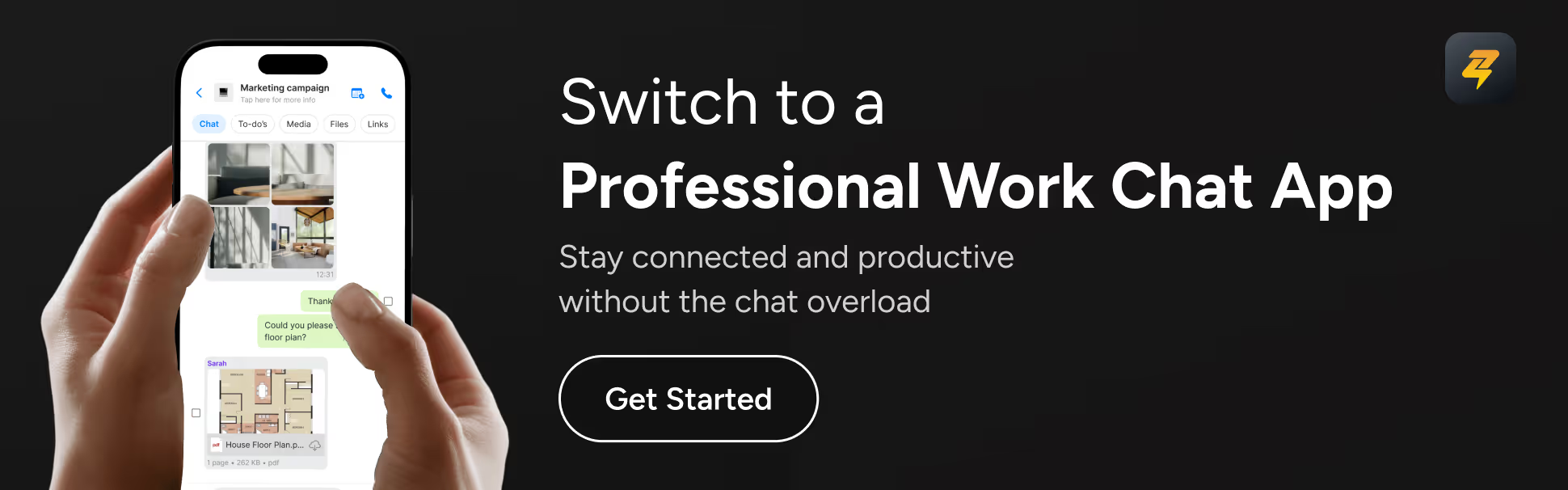
Zenzap is a mobile-first professional work chat app built for internal team communication that is simple, secure, and stress-free. It is designed to feel as fast and intuitive as your favorite personal messaging app, but it adds tasks, calendar integration, structured spaces, and enterprise-grade security around that experience.
Instead of trying to be a full patient engagement platform, Zenzap becomes your clean internal backbone. It keeps clinicians, front-desk staff, and operations aligned, while you continue to use your EHR or patient portal for clinical records and patient-facing workflows.
Security and compliance for clinical communication
Rocket.Chat security for healthcare teams
Rocket.Chat highlights security as a core selling point in healthcare. It offers encrypted messaging and can be deployed in environments that help organizations work toward HIPAA compliance. Because it is open source, IT teams can self-host, control data residency, and customize integrations with EHR or hospital systems.
For large hospital networks with strong internal IT, this level of control is attractive. You can embed Rocket.Chat in patient portals, add live chat to your website, and centralize both patient and staff communication in one configurable platform.
Zenzap security for distributed clinic teams
Zenzap is built from the ground up as a secure workplace messaging tool for distributed teams, including clinics with multiple sites or remote staff. It combines encrypted communication, secure file storage, and strict access control into one mobile-first app.
Where it really shines for clinics is in the everyday security details that often get missed:
• Work and personal chats are fully separated, so staff are not sharing lab results or shift changes next to family messages in personal apps.
• Admins control who joins each workspace, can revoke access instantly when staff leave, and keep all messages and files in a controlled, searchable environment.
• Onboarding and offboarding become clean. No more patient-sensitive group chats that live forever on a former nurse's phone.
Zenzap is designed on the principle that the safest tool is not the one with the most settings. It is the one your people will rely on for everything, automatically. Security is built in, not bolted on as a long list of configuration options that nobody has time to manage.
If you are a smaller clinic or a growing group practice, this "secure by default" approach can be far more practical than a complex platform that needs heavy IT involvement to stay compliant.
Ease of use and adoption for busy care teams
Rocket.Chat usability for clinicians
Rocket.Chat gives you a feature-rich collaboration environment. You can create channels, threads, integrations, and even custom workflows. For tech-savvy teams, this flexibility is a strength. You can tailor the environment to your specific needs.
The tradeoff is complexity. Like many enterprise collaboration tools, Rocket.Chat can feel heavy to non-technical users. Doctors, nurses, and front-desk staff do not have time for long rollouts or dense admin panels. If the official tool feels slow or confusing, they quietly return to SMS or personal chat apps for urgency.
In a clinical setting, that drop-off matters. Every time a care team defaults to personal messaging instead of the secure platform, your risk grows and your single source of truth erodes.
Zenzap intuitive simplicity for clinics
Zenzap is built around a different insight. If you want people to stop using consumer apps for work, the official tool must be just as fast, just as easy, and a lot more trustworthy.
That is why Zenzap focuses on intuitive simplicity as a primary security feature, not a nice-to-have. It feels like the personal messenger your team already knows, but behaves like a structured work tool. Most teams can start using Zenzap in under a day with almost no training. If your staff can text, they can use Zenzap.
For you as a clinic leader, this matters in two ways:
• Adoption is almost instant, so you do not burn weeks on training or chasing people into "the official app."
• Once they are in, they stay in. Conversations, tasks, and files naturally flow into one secure environment instead of drifting back into unauthorized tools.
That is how Zenzap becomes the communication backbone your clinic relies on, not just another icon on the home screen.
Structured organization and workflow fit for clinics
Rocket.Chat for structured clinical workflows
Rocket.Chat supports channels, private groups, and integrations. With the right setup, you can mirror your clinical workflows. For example, you might have channels by department (radiology, pediatrics), cross-functional case discussion rooms, or incident response channels.
Open-source flexibility means you can go further and integrate with EHR systems or clinical decision tools. For large organizations that can invest in designing and maintaining these workflows, Rocket.Chat can become a powerful hub.
The risk is that without a deliberate design, Rocket.Chat can spin into the same chaos you see in consumer apps. Too many channels, no clear structure, and no shared rules for how to use them. In a busy clinic, nobody has time to sort through that.
Zenzap structured organization inside chat
Zenzap tackles the organization problem directly inside chat. Every feature is designed to keep work clear and contained, so nothing slips through the cracks:
• Tasks live directly in the conversation, so a message like "Please call this patient by 3 pm" can become a trackable task without leaving the thread.
• Integration with tools like Google Calendar keeps schedules in sync. If you are planning a case review, you can see availability and create events in context.
• Conversations, tasks, and files are grouped in structured spaces, not random group chats. This makes it easier for new staff to find what they need and for managers to have oversight.
This structure is especially powerful for distributed clinics. A regional manager can see in one place what is active at each site, which tasks are assigned, and where there might be bottlenecks, without wading through a sea of unstructured chat.
In day-to-day clinic life, that might look like this: a nurse flags a missing lab result in the "Lab follow-ups" space, turns it into a task for the lab coordinator, and everyone can see when it is completed. No more wondering whether someone saw the message in a random group thread.
Mobile-first communication and work-life balance
Rocket.Chat mobile experience for healthcare
Rocket.Chat offers mobile apps so clinicians can stay connected on the go. For hospital teams that move between wards or for on-call staff who need access from home, this is essential.
However, Rocket.Chat is still built primarily as a broad collaboration platform. Work-life separation, notification hygiene, and burnout protection are not its central story. You can configure notifications and quiet hours, but you need to set that up and maintain it.
Zenzap mobile-first design and healthy boundaries
Zenzap starts from the mobile screen. It is explicitly designed as a mobile-first professional work chat app, which means every interaction is optimized for the clinician who is checking updates between patients, walking the ward, or splitting time between sites.
Just as important, Zenzap treats work-life separation as a first-class feature, not an afterthought:
• Staff can set working hours so they do not receive notifications when they are off the clock.
• You can schedule messages to be sent during business hours. If a clinic manager drafts a message at 10 pm, the system can deliver it at 8 am so you are not pinging nurses late at night.
• Work communication is kept in a dedicated professional space, separate from personal messaging apps, which reduces stress in evenings and weekends.
For clinics facing burnout and retention challenges, this matters. Your people need to unplug without missing what is truly urgent. Zenzap helps you build that culture by default.
Cost-effectiveness and tool consolidation
Rocket.Chat value for healthcare organizations
Rocket.Chat can be cost-effective for large healthcare systems that want an open-source platform they can tailor deeply. When deployed at scale, it can replace multiple communication tools and serve not just internal staff but also patient engagement use cases.
That said, the real cost includes hosting, configuration, security reviews, and ongoing maintenance. If you do not have a strong IT function, this overhead can eat into any license savings quickly.
Zenzap cost-effectiveness for clinics
Zenzap is designed to be up to 2 to 3 times more cost-effective than typical alternatives once you factor in reduced tool sprawl and productivity gains. Here is why:
• It replaces multiple apps. Tasks, internal chat, and calendar context live in one place, so you can often remove at least two other tools.
• Adoption is quick, so you are not paying for weeks of training or slow ramp-up.
• Work stays inside the secure app instead of leaking into personal channels, which reduces compliance risk and the potential cost of a breach.
For a multi-site clinic, this can add up fast. Instead of paying for a collaboration suite, a task manager, and a separate mobile messaging tool, you use one focused solution that does what your teams actually need in their day-to-day work.
Key takeaways
- Choose secure workplace messaging that your clinicians will actually adopt, or you will drift back into risky personal chat apps.
- Use Zenzap when you want mobile-first, intuitive internal clinic communication with tasks, calendar integration, and strong work-life separation.
- Consider Rocket.Chat if you have robust IT resources and need a highly customizable platform for both staff and patient messaging.
- Reduce costs by consolidating chat, tasks, and scheduling context into a single, secure professional chat tool for clinic communication.

Final thoughts for clinic leaders
Your messaging app is not just a utility. It quietly shapes how your clinic feels to work in every single day. It decides whether Monday starts with a calm, organized feed of what matters, or a scramble through half a dozen apps and mystery group chats.
Rocket.Chat gives you a broad, flexible collaboration platform that can fit complex healthcare environments, especially when you have IT muscle to configure and maintain it. Zenzap takes a different path. It starts with your reality as a busy clinic leader who needs clarity, not more complexity.
With Zenzap, you get one secure place for internal conversations, tasks, and schedules. Your team gets a messaging app that feels instantly familiar, yet protects patient data, supports clean onboarding and offboarding, and respects their time off. You reduce tool sprawl, close security gaps, and give your clinicians a calmer way to stay connected.
The choice is not just about features, it is about the kind of clinic culture you want to build. Do you want your communication tool to be another thing people fight, or the quiet backbone that helps your team deliver great care without burning out?
When you look at your current mix of tools, staff habits, and patient safety goals, which messaging app will your clinic trust enough to use for everything?
FAQ
Q: Is Rocket.Chat or Zenzap better for patient messaging in clinics?
A: Rocket.Chat can be a strong option if you want a flexible platform that supports both staff and patient messaging, and you have IT resources to integrate it into your patient portal or website. Zenzap is focused on internal team communication rather than direct patient messaging, so it pairs best with your existing EHR or patient portal for clinical records and patient-facing interactions.
Q: How fast can our clinic staff adopt Zenzap compared to Rocket.Chat?
A: Zenzap is designed to feel as familiar as consumer messaging apps, so most teams can start using it in under a day with almost no training. If your staff can text, they can use Zenzap. Rocket.Chat is feature-rich and customizable, which can mean a longer learning curve and more configuration before frontline staff feel fully comfortable.
Q: Can Zenzap really replace multiple tools in our clinic workflow?
A: In many clinics, yes. Zenzap brings chat, lightweight task management, and calendar context into one secure app. That often allows you to replace a separate task manager, reduce email clutter, and move away from ad-hoc personal messaging for work topics. The result is fewer tools to manage and less context switching for your team.
Q: How do Rocket.Chat and Zenzap handle staff turnover and access control?
A: Rocket.Chat provides admin controls and, when self-hosted, allows IT teams to tightly manage access and data retention. Zenzap focuses on making secure onboarding and offboarding simple for clinics: admins control who joins each workspace, can revoke access instantly when staff leave, and keep all messages and files inside a controlled, auditable environment so sensitive information does not linger in personal apps.
Q: Which tool is better for preventing staff burnout related to messaging overload?
A: Both tools offer notification controls, but Zenzap is designed specifically with work-life separation in mind. Staff can set working hours, managers can schedule messages to send during clinic hours, and work chats are clearly separated from personal apps. This makes it easier for your team to unplug confidently, while still staying on top of truly urgent issues.
Q: Do we need a large IT team to manage Zenzap or Rocket.Chat in our clinic?
A: Rocket.Chat is ideal if you have an internal IT team that can handle deployment, configuration, security reviews, and integrations. Zenzap is built to minimize that overhead. It is a managed, mobile-first work chat app that gives you enterprise-grade security and admin controls without requiring deep technical resources, which is often a better fit for small to mid-sized clinics and distributed care teams.

Take Control of Your Team Communication
Chat, organize, and get work done - all in one place.
Other Blog Posts